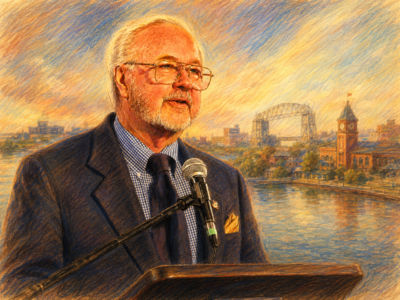
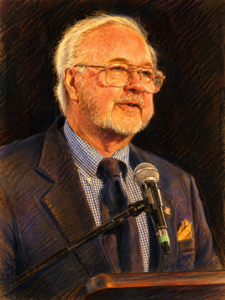
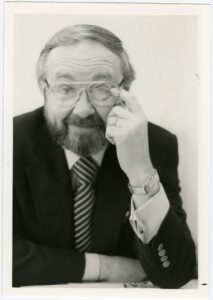
 Morley Lorne Torgov, the Toronto lawyer and twice Leacock-winning author whose warm, wry fiction drew heavily on his Jewish childhood in Sault Ste. Marie, died July 19, 2026, at the age of 98.
Torgov sustained two substantial careers over much of his long life. He practised law in Toronto for roughly 70 years while also establishing himself as a prominent Canadian Jewish humorist and novelist.
I remember Morley as an amiable, intelligent wordsmith who somehow found time for writing fiction evenings and on weekends while maintaining a demanding professional routine as a lawyer. Retirement, or even slowing down very much, seemed to hold little attraction for him.
“Frankly, I prefer it like this,” he told me soon after his novel The War to End All Wars was published. The book had taken him 17 years to write. “I like it when my phone rings all the time. I like to keep busy. You know what trouble is? Trouble is when you don’t have any trouble any more.”
Torgov was born in Sault Ste. Marie, Ontario, on December 3, 1927, the only child of Allen Torgov and Sarah Jane Torgov. His father was associated with Allen’s Ladies Wear, and Torgov’s childhood in the city’s small Jewish community became a central imaginative source for much of his fiction.
As a boy, he was drawn more to books and music than to athletics. During the Second World War, while still a teenager, he worked summers as a cub reporter for the Sault Daily Star. He later credited that newspaper experience with helping him learn how to write.
 He received a BA from the University of Toronto in 1950 and then studied law at Osgoode Hall. Called to the Ontario bar in 1954, he specialized principally in real estate and corporate and commercial law and became senior partner in the Toronto firm Olch, Torgov and Cohen.
In 1952 he married Anna Pearl Cohen in Toronto. They were married for 74 years. Their children were Sarah Jane Torgov, who became an actress and artist, and Alexander Torgov, who predeceased his father. Torgov is survived by Anna Pearl, Sarah, son-in-law Douglas Steinberg, daughter-in-law Carrie Schipper Torgov, and four grandchildren: Benjamin, Sydney, Rebecca and Marshall.
His literary career developed alongside his legal practice. Before his first book appeared, he wrote for radio, newspapers and magazines.
His breakthrough came with A Good Place to Come From in 1974, a series of interconnected autobiographical stories about growing up Jewish in Depression-era and wartime Sault Ste. Marie. The book explored family, synagogue life, relations between Jews and non-Jews, childhood embarrassment, food, commerce and the peculiarities of a small Jewish community, all observed with a dry and gently satirical eye.
Although dark things happen in Torgov’s fiction, he preferred prose that moved lightly.
“I have difficulty looking at any subject with what Woody Allen used to call ‘total heavy-osity,’” he said. “I can’t stand prose that is dense and steeped in that ‘total heavy-osity.’ One of my literary idols is Elmore Leonard, who said one of the most clever things I’ve ever heard a writer say. In an interview he was asked, ‘To what do you attribute the success of your prose?’ He replied, ‘I leave out the parts people don’t want to read.’”
A Good Place to Come From proved to have an appeal well beyond its Jewish setting. It won the Stephen Leacock Memorial Medal for Humour in 1975, and several of its stories were adapted into CBC television dramas.
“I was flabbergasted after it came out, and I got cards and letters from many people saying that my experience had been just like theirs as a Catholic or a Ukrainian in a small town,” Torgov said.
Although he spent most of his adult life in Toronto, he returned often in his fiction to small-town settings resembling the one in which he had grown up.
 “I don’t look on small-town life with a romantic eye,” he said. “Small-town people have a way of nosing into each other’s lives, and even lacerating each other, that is anything but folksy.”
His second book, The Abramsky Variations (1977) continued his interest in Jewish family life and was a finalist for the Books in Canada First Novel Award.
Then came the novel for which he is probably best remembered, The Outside Chance of Maximilian Glick (1982), about a Jewish boy, musical ambition, family expectations and an Orthodox rabbi in a small Canadian community. Torgov received his second Stephen Leacock Medal for the book in 1983.
It was adapted for the screen in 1988. Directed by Allan A. Goldstein, the film was named Best Canadian Feature Film at the Toronto International Film Festival that year.
His other books include St. Farb’s Day (1990), The War to End All Wars (1998) and Murder in A-major (2008). With the latter, Torgov moved into historical crime fiction, creating Inspector Hermann Preiss and placing murder mysteries in the world of nineteenth-century German music. He returned to that setting in The Mastersinger from Minsk (2012).
Torgov received honorary doctorates from Algoma University and Laurentian University in 1990. He was inducted into the Sault Ste. Marie Walk of Fame in 2006 and was appointed a Member of the Order of Canada in 2015. In 2025–26, Sault Ste. Marie awarded him its Medal of Merit, the city’s highest civic honour. At 98, he characteristically joked that he assumed he was receiving it for the “simple miracle of longevity.”
His papers are preserved by the Ontario Jewish Archives in the Morley Torgov fonds, which includes drafts, working files, research material, correspondence, speeches and memorabilia.
If Torgov deserved one further distinction, it might have been for his extraordinary talent for making use of time. He believed that remaining mentally engaged was itself a way of remaining young.
“I could never sit at home all day, or go to the golf course, or park my behind on a beach chair by a pool in Florida,” he said. “I honestly believe that the more you use your brain, the younger you stay.
“I find that the daily challenge of coming to work and dealing with problems in the real world is very stimulating. It’s always very aggravating at times. It may not keep me forever young, but it certainly keeps me younger than I actually am.” ♦