In the early years of the twentieth century, Jewish immigrants from Ostrowiec, Poland, began establishing a new community in Toronto. Most had come from modest circumstances, leaving behind familiar surroundings, established family relationships, and the religious and cultural life of their hometown.
Many were young craftsmen and workers who had emigrated to escape poverty, economic discrimination, and the threat of conscription into the Russian army. Some left wives and children behind, hoping eventually to bring them to Canada. The adjustment was often difficult, and a number of immigrants considered returning to Poland.
In Toronto, the newcomers naturally sought the companionship of others from Ostrowiec. They were known as Ostrovtzer landsleit, people who shared a common hometown and heritage. Their first major undertaking was the establishment of a synagogue, which would serve not only as a house of worship but also as a gathering place and a source of assistance to those in need.
The Founding of the Ostrovtzer Congregation
The congregation originated at a gathering of approximately twenty immigrants in the Elizabeth Street home of Leibish Zukerman, who, many years later, vividly recalled the occasion. Over beer and refreshments, the men discussed their desire to establish a synagogue that would preserve the religious traditions of Ostrowiec.
Among the founders were Aaron Warshavsky, Herschel Bucovsky, Abraham Lerenbaum, Leibish Zukerman, Jacob H. Fish, Jacob H. Fachler, Shlome Kirshenblatt, Aba Fidler, Meir Singer, and Hershel Lerenbaum.
Other early members included E. Marcovetsky, Zelig Weinberg, Lipe Silverman, Leibish Blum, Abish Rubinstein, Samuel Wagner, Yankel Blum, Motel Fidler, Jacob Singer, Yudel Fish, Meir Rochwarg, Shloime Davidson, Alater I. Halpern, Meyer Yechiel Finkelstein, Isaac Kempal, Pinya Steinbeck, Abraham Z. Linzon, Abraham Fisher, and Hershel Linzon.
The synagogue was originally called Tifereth Yisrael Bikkur Cholim, a name emphasizing the importance of caring for the sick and needy. Its founders envisioned a threefold purpose: religious worship, fellowship among immigrants from Ostrowiec, and charitable assistance to the poor and homeless.
In the early decades of the twentieth century, many Jewish immigrants lived precariously. Some were without regular employment, adequate food, or permanent accommodation. The congregation helped newcomers cope with these hardships while maintaining their connection to the community they had left behind.
From Elizabeth Street to Cecil Street
The early Ostrovtzer congregation occupied a succession of modest premises in downtown Toronto.
Its first meeting place was on Teraulay Street, now Bay Street. The congregation subsequently moved to Elizabeth Street, where it rented rooms behind the home of Lazar Borenstein, an immigrant from Iwaniska.
Further moves took the congregation to St. Patrick Street and then to Centre Avenue, where it purchased its first building.
Hershel Bukovsky served as the first president at the Centre Avenue location, followed by Elyahu Markovitch, father of the Toronto physician Dr. Charles Markson.
The Centre Avenue synagogue was small and poorly suited to its growing congregation. Men worshipped downstairs, while the women occupied the upper floor. Unfortunately, the ceiling was so thick that the women could not hear the prayers below.
Holes were therefore bored through the ceiling to permit the cantor’s voice to reach the women’s gallery. The arrangement sometimes produced considerable confusion as the women crowded around the openings to hear the service.
As membership continued to increase, the congregation began looking for more suitable quarters.
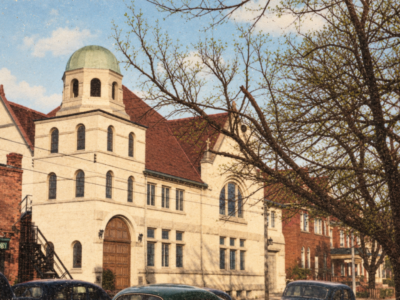
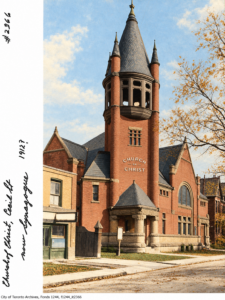 A turning point came when David Sussman learned that a church at the corner of Cecil Street and Spadina Avenue could be purchased for $20,000.
At the time, the synagogue treasury contained only $300. Many members considered the proposal financially reckless, but Sussman persisted. Eventually a meeting was held at which $2,000 was raised for a down payment, enabling the congregation to purchase the building.
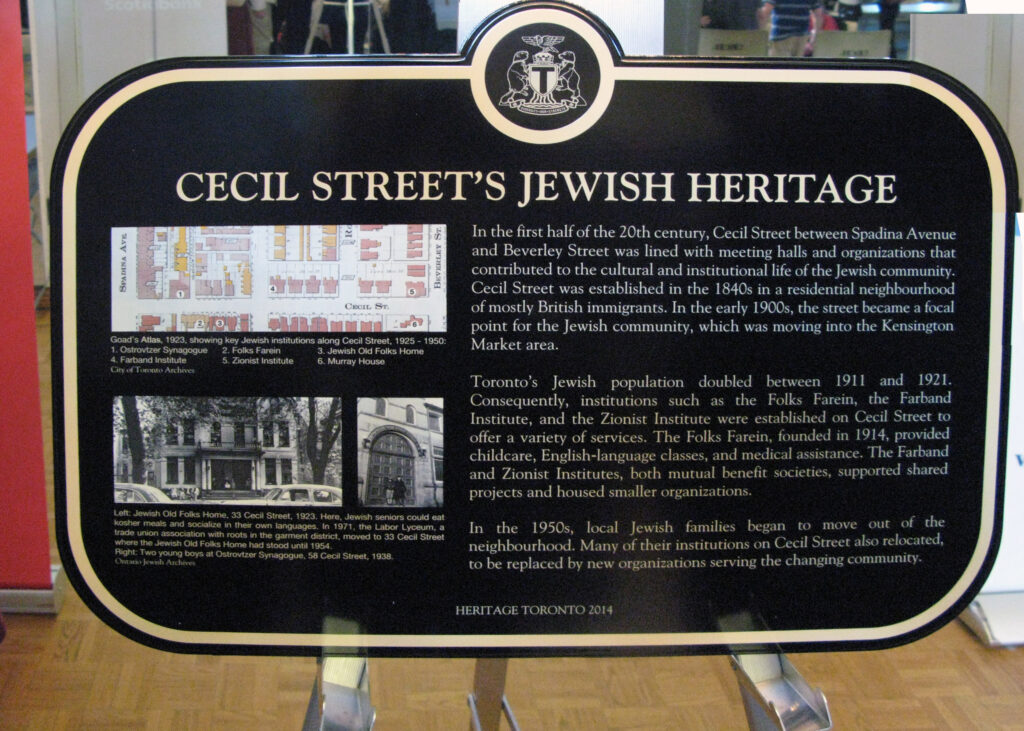
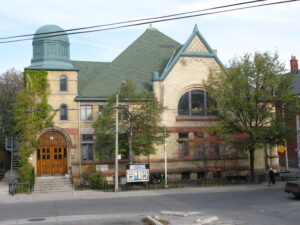
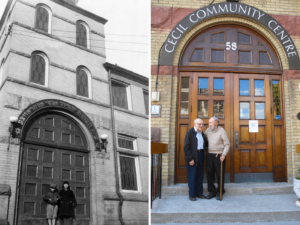
The former church became the home of Beth Hakenesset Hagadol Anshei Ostrowce, generally known as the Ostrovtzer Shul, at 58 Cecil Street.
The synagogue eventually became an important landmark in Toronto’s Jewish district. By 1950, approximately $75,000 had been spent on purchasing, improving, and modernizing the building.
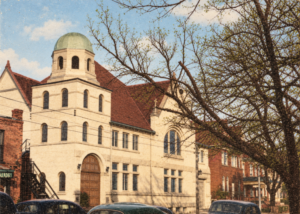 Among those especially active in its affairs were Abraham Z. Linzon, the congregation’s first president and a leading advocate of modernization; David Sussman; Israel Weinberg, who served as president for more than ten years; J. Rosenberg, secretary for twenty-six years; H. M. Grossman, vice-president; and Isaac Gotlieb, treasurer.
Other prominent members included L. Zucker, Abraham Linzon, Abie Lerenbaum, and the brothers Abraham and Feivel Fidler.
Two Congregations Become One
The Ostrovtzer immigrants did not always agree on the organization of their religious affairs.
A later wave of immigrants, many of them artisans and workers who had left Poland shortly before the First World War, established a separate congregation on Chestnut Street, in the home of Shloime Grossman.
This second synagogue placed particular emphasis on providing food and shelter to newcomers in difficult circumstances.
Eventually, differences between the two groups were resolved. Reforms were introduced into the original congregation, giving members a greater voice in its administration, and the two synagogues merged.
Two important provisions were subsequently added to the constitution: no Jew from Ostrowiec could be excluded from membership, and the congregation’s name must always include the words Anshei Ostrowce, meaning “Men of Ostrowiec.”
These provisions reflected the enduring attachment of the members to their birthplace.
 The Ostrovtzer Societies
In addition to the synagogue, the Ostrovtzer Jews of Toronto organized three principal fraternal and charitable associations: the Ostrovtzer Hilfs Farein, the Ostrovtzer Ladies Auxiliary, and the Ostrovtzer Independent Mutual Benefit Society.
Both the Hilfs Farein and the Ladies Auxiliary originated as branches of the synagogue before becoming independent organizations.
The Hilfs Farein raised money for impoverished Jews in Ostrowiec. Until the Second World War, two separate relief societies operated in Toronto, but they eventually merged. After the Holocaust, the combined organization provided assistance to surviving Ostrovtzer Jews in displaced-persons camps and to those who had reached Israel.
The Ladies Auxiliary also played an important role in the development of the synagogue. Its members donated the Holy Ark, a curtain for the Ark, and a wedding canopy, and helped finance improvements to the building.
 The society was founded approximately twenty-five years before the 1950 jubilee celebrations. Its first president was Mrs. Rochele Lerenbaum, with Mrs. David Sussman serving as first vice-president.
Other early officers included Alte Rubinstein, Tobele Farber, Rose Stern, Chana Bloom, and Sarah Appel.
At the time of the jubilee, the president was Rochele Weinberg, who had also been the society’s first secretary. Other officers included Yente Sher, Chana Bloom, Rachel Borenstein, Itta Weisfeld, and Sima Gotlieb, together with Mrs. Linzon and Rochele Grossman, who served as hospital visitors.
 Through visits to Ostrowiec by David Sussman, members of the Ladies Auxiliary established personal relationships with families in their hometown, strengthening their commitment to relief work.
The Toronto societies also maintained contact with Ostrovtzer survivors in Israel. Their archives contained letters from residents of Ostrowiec, including correspondence from Rabbi Chatzkele Halevi, son of the celebrated Ostrovtzer rabbi.
Following the war, the societies considered establishing a colony or community centre in Israel to commemorate their destroyed hometown.
 Ostrowiec: The Community They Left Behind
To understand the attachment of the Toronto immigrants to their birthplace, it is necessary to consider the character of Jewish Ostrowiec in the years before the First World War.
Ostrowiec, in central Poland, was home to a large and intensely traditional Jewish community. Its religious life was strongly influenced by Hasidism, with numerous small synagogues and prayer houses representing different Hasidic dynasties.
Among the most prominent were followers of the Gerer, Alexander, Vorker, Skierniewicer, Kozimirer, Szydłower, and Ożarower rabbis. Altogether, the town had nearly forty such prayer houses, known as kloyzn or shtiblekh.
Workingmen also established congregations associated with their trades, combining religious worship with companionship and mutual assistance.
The most influential religious figure in the town was Rabbi Meir Yechiel Halshtock, the celebrated Ostrovtzer Rav, who occupied the rabbinate for more than forty years.
Born into a modest family, Rabbi Halshtock displayed remarkable Talmudic abilities as a child and became a rabbi while still a teenager. He eventually settled in Ostrowiec, where he remained until his death in 1928.
Renowned for his scholarship, ascetic habits, and generosity, he exercised a profound influence on the community. Unlike some Hasidic leaders, whose gatherings emphasized ecstatic singing and dancing, Rabbi Halshtock placed the greatest importance on religious learning and intellectual discipline.
He lived simply and was known for his extraordinary fasting, often taking little more than a glass of boiled milk before retiring.
Despite his personal austerity, he showed particular kindness to the poor. When disputes arose over money or property, he was distressed by the attention devoted to worldly possessions. Fees he received were frequently distributed among those in need.
One story illustrates his character. Whenever he travelled to neighbouring towns, he preferred to employ a poor and rather inept coachman named Meir’l Yushu, whose horse was notoriously decrepit. Although more prosperous drivers were available, the rabbi deliberately chose Meir’l, thereby providing him with an income and demonstrating that the poor deserved the same consideration as the wealthy.
Rabbi Halshtock’s memory remained an important part of the Ostrovtzer identity in Toronto. The congregation’s constitution required that the anniversary of his death, on the seventeenth of Adar, be commemorated annually. Members gathered for a dinner at which stories of his scholarship and good deeds were retold.
Work, Poverty, and Emigration
Although Ostrowiec was noted for its religious scholarship, it was also an industrial town, dominated by a large steelworks employing thousands of workers.
Jewish merchants and shopkeepers depended heavily on the trade generated by the factory. Because workers received their wages twice monthly, shopkeepers commonly sold goods on credit, recording purchases in ledgers and collecting payment on payday.
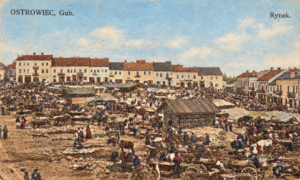
Another important source of livelihood was the twice-weekly market, when peasants from surrounding villages arrived with agricultural produce and purchased supplies from Jewish merchants.
Many Jews worked as tailors, shoemakers, cap-makers, and small traders. Most lived modestly, while some endured considerable poverty.
Money sent home by relatives in North America provided an important supplement to the local economy.
At the beginning of the twentieth century, economic insecurity, antisemitism, and political unrest encouraged many young Jews to emigrate.
The first substantial wave followed the revolutionary disturbances of 1905 and the accompanying fear of anti-Jewish reprisals. A second wave developed in the years immediately preceding the First World War, when craftsmen and small traders increasingly concluded that they had little prospect of improving their circumstances in Poland.
Many emigrants found the adjustment to Canada difficult. They struggled with unfamiliar languages and occupations, and some were unable to earn enough even to send for their families.
The Ostrovtzer synagogue and mutual-aid societies helped bridge the distance between the world they had left behind and their new lives in Toronto.
The Destruction of Jewish Ostrowiec
Before the Second World War, Ostrowiec had a Jewish population exceeding 18,000. Its synagogues, schools, religious institutions, markets, and neighbourhoods represented centuries of communal development.
That world was destroyed during the Holocaust.
The town’s Jewish population was decimated, its institutions ruined, and its cemetery desecrated. For the Ostrovtzer immigrants in Toronto, the destruction was an intensely personal tragedy, involving relatives, friends, neighbours, and the familiar places of their childhood.
Inside the Cecil Street synagogue, a panel of photographs depicted the devastated hometown: rubble-strewn streets, ruined buildings, and broken gravestones. These images became a permanent reminder of what had been lost.
The synagogue itself acquired a meaning its founders could never have anticipated. Originally established to serve immigrants who longed for the religious and social life of their birthplace, it had become a memorial to a community that no longer existed.
 The Later Years and the Ostrovtzer Legacy
By the time of the synagogue’s fortieth-anniversary celebrations in 1950, the Ostrovtzer Jews had become firmly established in Toronto.
Many had prospered, raised families, and moved away from the downtown neighbourhoods in which they had first settled. The Jewish population gradually left the area surrounding Cecil Street, and the synagogue’s original function as a neighbourhood institution diminished.
In a later account, plans were described to sell the synagogue and devote the proceeds to constructing an Ostrowiec House in Israel, intended both as a memorial to the destroyed community and as a cultural and social centre for Ostrovtzer Jews throughout the world.
Whether through religious worship, charitable assistance, mutual-benefit organizations, or the preservation of historical records, the Ostrovtzer Jews of Toronto demonstrated a remarkable devotion to their common origins.
Their institutions helped sustain newcomers during the difficult years of immigration, provided assistance to their relatives in Poland, and later supported survivors of the Holocaust.
Above all, they preserved the memory of Ostrowiec and the Jewish community that had flourished there for generations. ♦
◊ Adapted and condensed from an account published in the 1950 Jubilee Book of the 40th Anniversary of Beth Hakenesset Hagadol Anshei Ostrowce, subsequently reproduced in the Ostrowiec Yizkor Book.
Read the complete original article: Ostrovtzer Shul in Toronto — JewishGen Yizkor Book
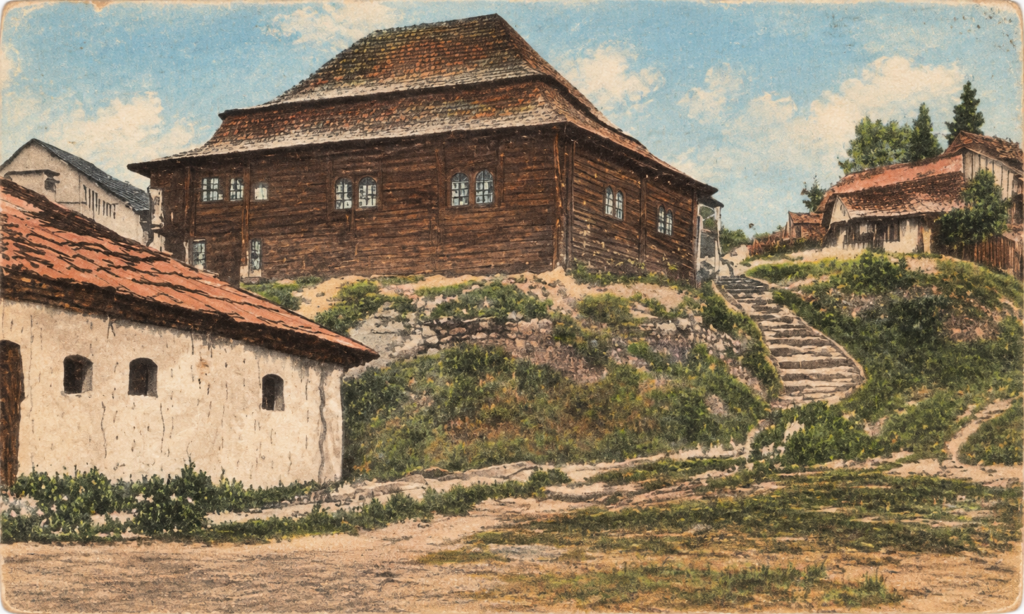
Top: The historic wooden synagogue of Ostrowiec, Poland. The neighbouring buildings include the old synagogue and the mikveh (ritual bathhouse) in the foreground. From Sefer Ostrovtsah, the Ostrowiec Yizkor Book, page 17. Modern colourization in the style of an early twentieth-century postcard.
Further down: Market Day in Ostrowiec – the bustling market square (Rynek) of Ostrowiec, Poland, in the early twentieth century, crowded with merchants, townspeople, market stalls and horse-drawn wagons. From Sefer Ostrovtsah, the Ostrowiec Yizkor Book, page 14. Modern colourization in the style of an early twentieth-century postcard.
N.B. These are AI-generated postcard-style interpretations, not historically authenticated colour photographs. The colours and some architectural details may not be faithful to the original images.
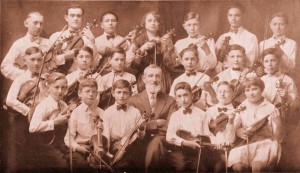
Ovstrovtser youth choir, led by Mr. Barsh, 1930.
Gordon Perlmutter and Gurion Hyman, z”l stand on the Ovstrovtser doorstep in 1938 and 2014. (OJA/BG)
Image of the church building of 1912, courtesy City of Toronto Archives, colourized by ChatGPT.
The former shul is now the Cecil Street Community Centre, on Cecil just east of Spadina on the north side.