by Mordecai Hirshenson
from the “Canadian Panorama,” Canadian Jewish News, August 12, 1960
NEW SYNAGOGUE MERGER
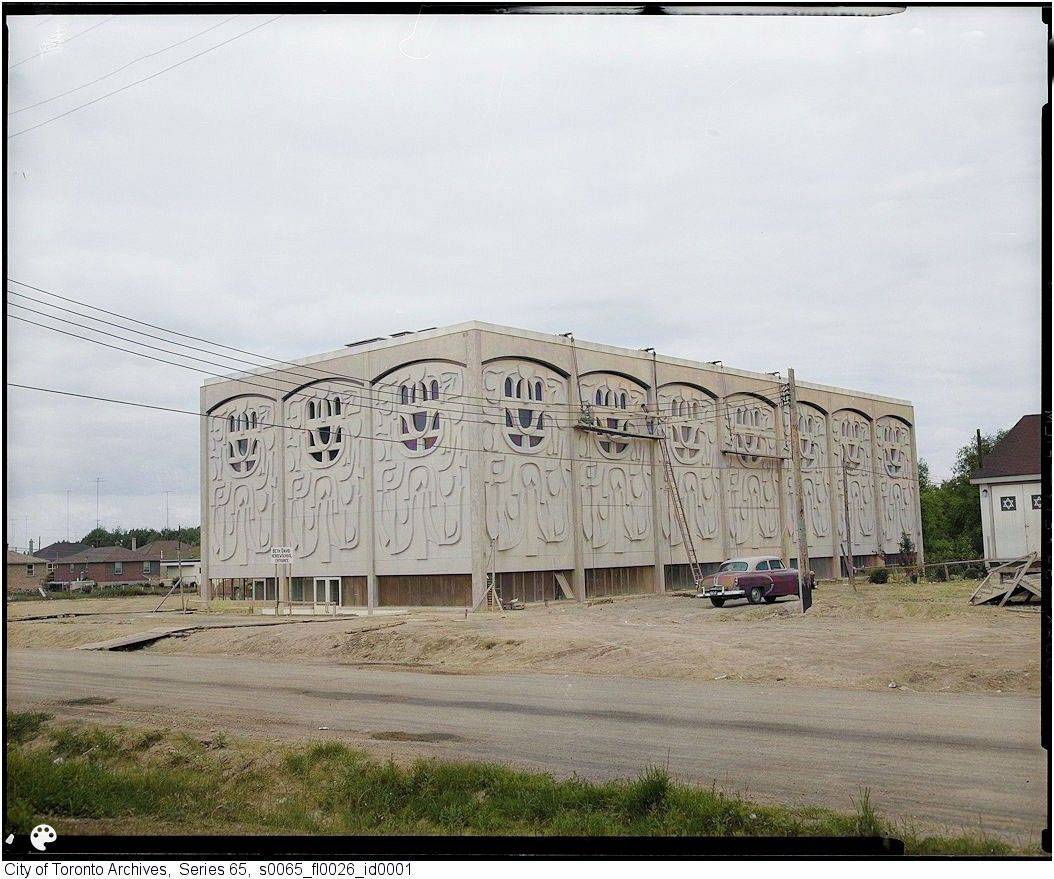
Another synagogue merger is taking place in Toronto — the city’s second in a period of only months. The Shaw Street — or more formally the B’nai Israel — is fusing its identity and membership with an uptown congregation, the Beth David, located on Yeomans Road in the Bathurst and Wilson area of North York.
 The Shaw Street congregation, which, as its name indicated faced Shaw Street, was located in the lush and verdant background of Bellwoods Park in west-central Toronto and was long a landmark in this outpost of Jewry, having been established in the area in the early 1920s. It never had a permanently attached rabbi, its worship being so securely familiar with the order of the prayerbook that they had no need of anyone other than their own ba’alei t’fillah to lead them. From time to time the High Holy Days sermons would be delivered by a visiting rabbi or by one of their own more learned laymen. One of the latter was the late Mr. Coppel, a pink-skinned, cherubic-faced Jew with a pointed white Van Dyke who was a well-known and beloved figure among the members.
The Shaw Street building was sold some time ago and in looking about for a suitable relocation the members decided to throw in their lot with the new Beth David. Like the Bais Yehuda-Shaarei T’fillah amalgamation earlier this season, this was the union of a synagogue more than 30 years old with one of about five years of age.
One difference is that this is a “mixed marriage”, the Shaw Street Shool being traditional and the Beth David Conservative.
Rabbi of the new congregation will be the Beth David’s Albert Pappenheim. Rabbi Pappenheim is one of the German-Jewish internees who were sent over from England in 1940 and later released. He received s’micha in Toronto from Rabbi Abraham A. Price, served in St. Catharines, Ontario and Lexington, Tennessee before he returned to Toronto to take the Beth David pulpit.
A DECADE OF SYNAGOGUE GROWTH
 Fifteen new synagogue structures have been erected in Toronto since 1950. They include the Beth Am in Downsview; the Beth David, Beth Emeth, Shaarei Tefilla, Adath Israel, Temple Sinai, Torah Emeth, Clanton Park, Beth Joseph, and Beth Itzhak, all in central North York; Beth Tzedec, Torah V’Avodah and Ahavas Achim, in York Township; and Beth Lida in Forest Hill. The newest to go up is Don Mills’ Beth El now under construction (it was damaged during the recent work stoppage of construction laborers).
 The above list does not include new local congregations like Temple Emanuel nor “ex-urban” congregations in Oakville and Richmond Hill which have not yet put up permanent structures, nor congregations that have moved into renovated churches like the Anshei Chmelnik (now on Winona Drive) nor synagogues that have added substantial new wings like the Holy Blossom, Beth Sholom or Shaarei Shomayim.
MORE ABOUT SYNAGOGUES AND SOME LOCAL HISTORY
AN OBSCURE SHOOL
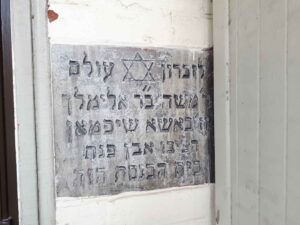 On D’Arcy Street a few doors east of Beverley, the passerby may notice a small plaque beside the door of an obscure dwelling house — a plaque that bears some half obliterated Hebrew lettering. Most passerby, rarely seeing any entering or leaving, would take it for a former shtibl or house of prayer. However it is still in existence as a house of prayer, is known as the B’nai Moishe and possesses cemetery grounds in the Roselawn area — perhaps it is Toronto’s smallest synagogue, though for this title there are plenty of downtown establishments that could give it stiff competition such as the Anshei Slipia on Oxford Street, the Anshei Moldavia on Augusta, the pretentiously named Anshei New York on Lower Huron Street, or the Anshei Shidlow, two blocks further west on D’Arcy Street.
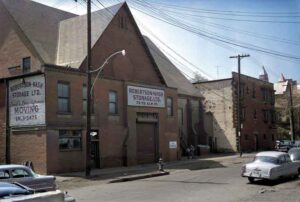 On Elm Street just a shade east of Elizabeth Street, in the heart of the old downtown “Ward,” behind the grimy exterior of the Robertson-Nash carriage warehouse can be seen the outline of what must have once been a stately house of worship*. Consultation with N. Shemen’s “History of Jewish Orthodoxy in Toronto” reveals that this structure used to house the “Polish Synagogue”, i.e., Beth Jacob, which almost 40 years ago moved several blocks west to Henry Street where it now possesses what is perhaps the finest synagogue building of the traditional type in the city (though it, in turn, is again located in an area now rapidly losing its Jewish inhabitants).
THE MISSIONARY CONTROVERSY ON ELIZABETH STREET
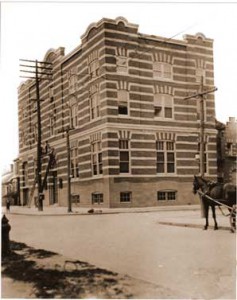
This Elm Street building is situated directly across the road from an office building whose cornerstone marks it as being built in 1912. Though now a banner and regalia factory, it was up to recently the head office of the Presbyterian Church in Canada. When it was planned in the years before World War I, it created somewhat of a sensation in the city’s Jewry as the Presbyterian Church intended it as a mission centre and for that reason erected it right slap in the middle of what was then a teeming Jewish quarter. Rabbi Solomon Jacobs, English-born and British-trained spiritual head of the Bond Street synagogue (Holy Blossom) denounced the plan vigorously in a fighting sermon in June, 1911, urging the Presbyterian Church to turn its attention to its own drunkards, backsliders and “fallen women” before it should seek to fish for Jewish souls. The sermon was published, in full, in the daily newspapers of the day and it is credited with giving a crippling blow to missionary activities directed at the Jews, which, though they continued — and still do — have never been maintained at the same tempo and pitch as before.
A LANDMARK OF AN ERA
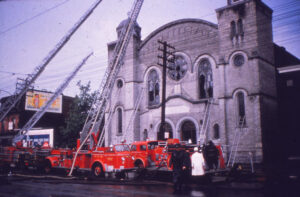 The fire that gutted the interior of the Men of England Synagogue on Spadina Avenue during the recent lightning storm finished off that building and it is now coming under the wrecker’s axe. The “Londoner Shul”, as it is commonly known, was for 40 years the outstanding landmark of Spadina Avenue, overtowering in its dignity and grace the whole spacious avenue between old Knox College to the north and the garment jungle to the south. It was converted from a church in Toronto’s previous synagogue building heyday which was also a post-war period. It is symbolic that the structure — ca. 1921 to 1960 — coincided with the hegemony of Spadina Avenue on Jewish life in Toronto. ♦
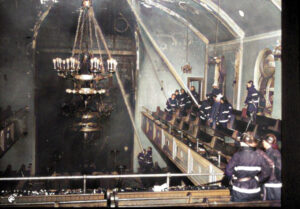 Photos: From the top, Beth David on Yeomans Rd (ca 1955); Shaw Street Shul (ca 1926); Ahavas Achim (ca 1967), Speisman Collection; Beth Lida (ca 1966), Speisman Collection; plaque on D’Arcy Street; Robertson-Nash building (ca 1950s); Presbyterian Mission House at Elm & Elizabeth, 1913; fire brigade attending Hebrew Men of England synagogue, exterior & interior, (ca 1960), Speisman Collection.
* The author is incorrect on this point. The carriage warehouse used to be Grace Church, which about 1910 became a Jewish dance hall!