From Globe, September 24, 1901
SACRED SCROLL THREATENED
Excited Jews Besiege a Burning Synagogue
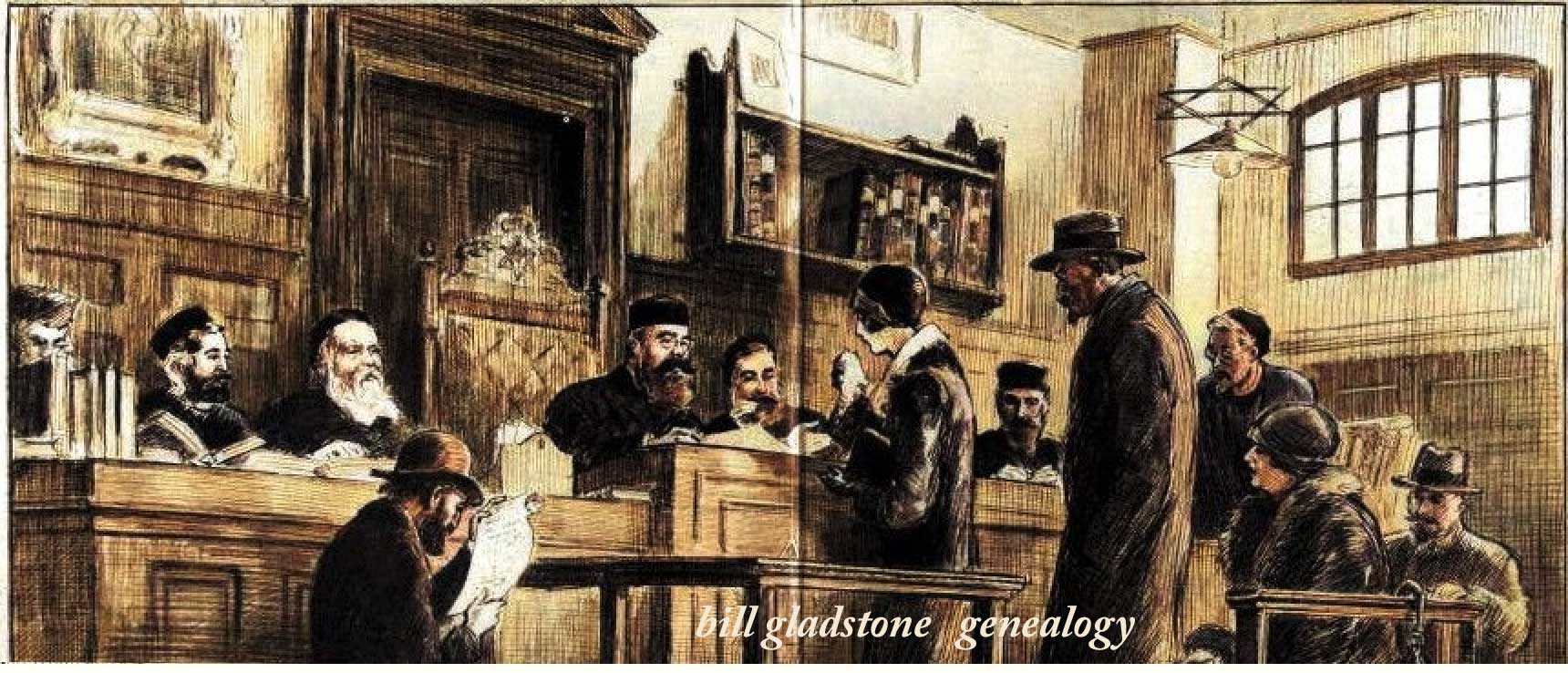
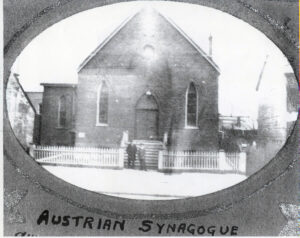 The sacred scroll in the Austrian Jewish Synagogue in Chestnut street, containing the laws as set down by Moses, was threatened with destruction at 1.30 o’clock this morning.
Fire broke out in the rear of the edifice and when the Jews of the neighbourhood awoke to find that the scroll was in danger they hurried half-dressed from their houses and besieged the burning synagogue.
But a posse of policemen under Sergt. Varley was already stationed at the gates leading to the entrance and refused to allow anyone to pass. Then the increasing throng of excited Jews threw themselves upon the policeman and for a time it looked as if a riot would occur.
They called loudly for their Bible, and the manner in which they acted showed undoubtedly that they were in extreme anxiety. Several Jewesses even clutched the officers’ coats and demanded entrance to the church to secure the scroll.
The firemen from the downtown sections were soon upon the scene, but the flames were shooting forth freely, which served to increase the excitement of the Jewish mob.
At last, when it looked as if force would be resorted to to secure the scroll, a well-dressed Jew, who spoke English fluently, told the policemen that if they didn’t make way and allow one at least of the Jews to go in and get the scroll, even at the risk of his life, there would certainly be a riot.
 He said that the Jews would rather lose their lives than see the scroll burned, for yesterday was Atonement Day, and the burning of the scroll would mean to them a curse from God.
With that, Leo Gelber, first president of the synagogue, escorted by foreman Wm. Smith of the Lombard street fire hall, was allowed to enter.
A few minutes later he returned with the scroll, and immediately there was a great calm. The Jews quietly dispersed to their homes, knowing that the scroll, though damaged somewhat, was fairly intact and heeding not the fate of the synagogue.
The fire started in the basement. Policeman Matthias saw the flames and also the terrified caretaker and his family at the basement window. The policeman kicked the window in and assisted the occupants, eight in all, to escape.
The fire was soon controlled. The damage amounts to several hundred dollars. The scroll cost the Jews about $600, and is made of parchment. The cover itself cost $200. ♦
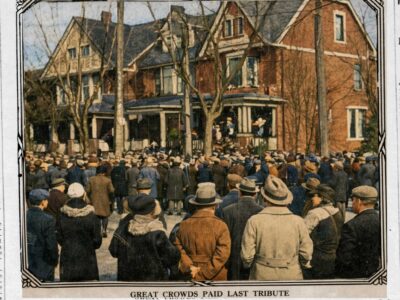
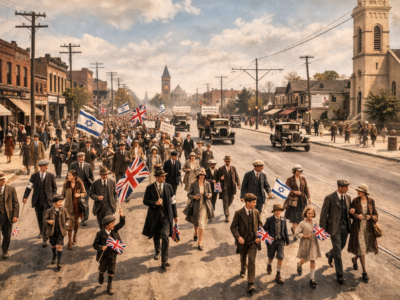
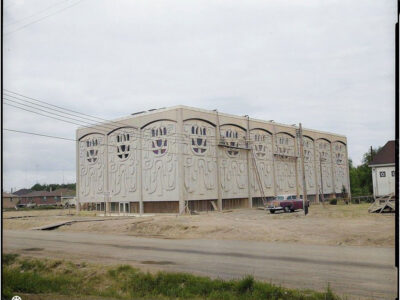
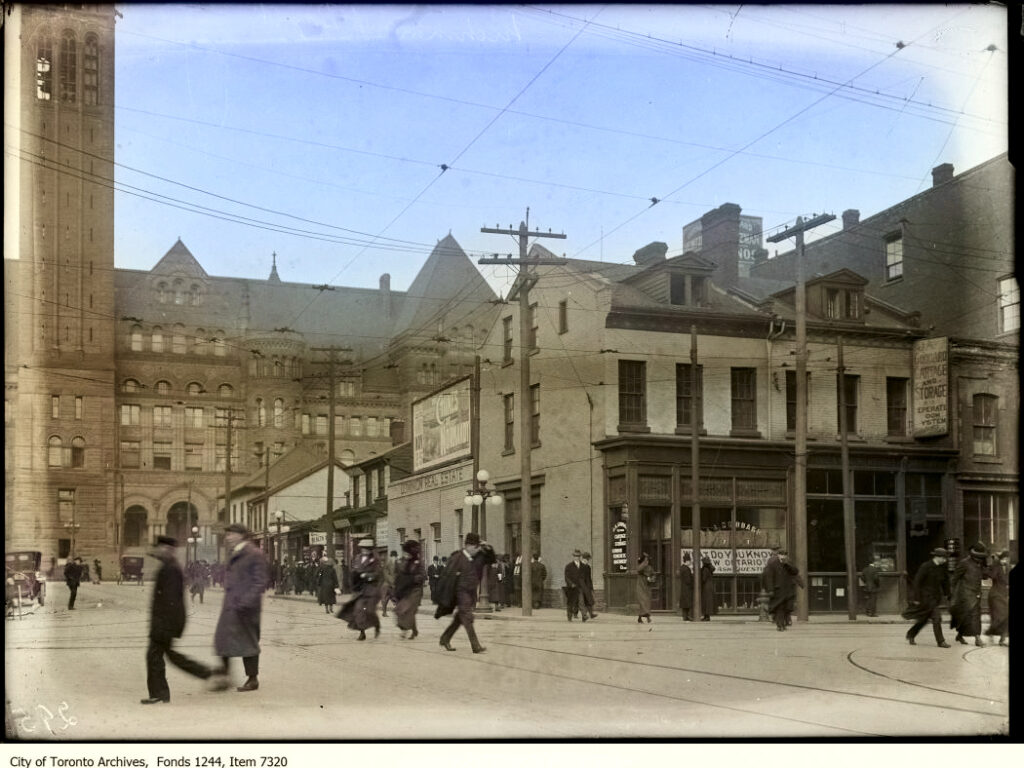
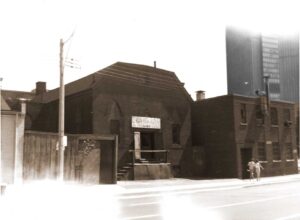
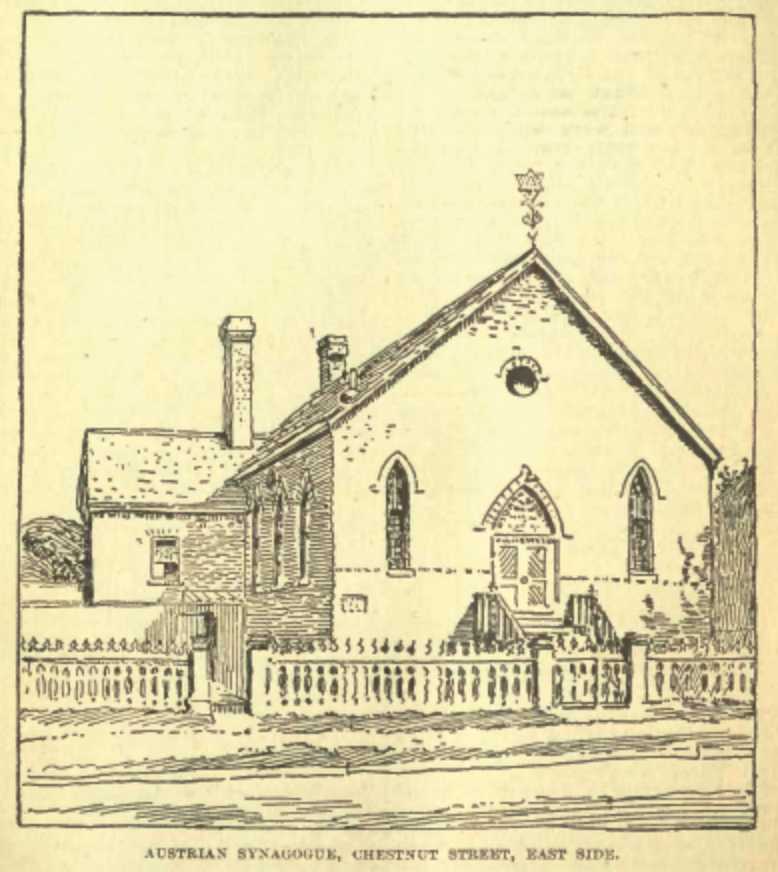
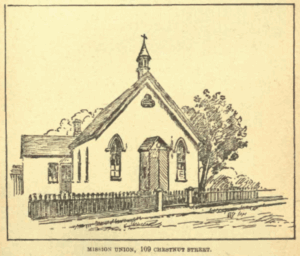
Photos: Top, corner of Terauley [Bay] & Richmond, looking north towards Old City Hall, ca 1911 (CTA – colourized); “Austrian Synagogue,” ca 1901-1910, courtesy Ontario Jewish Archives; photo of former synagogue on Chestnut Street, converted into a bag factory, in its last days, with new City Hall in background, ca late 1960s – photo by Stephen Speisman, copyright 2025, usage allowed with credit. Below, the building as it appeared ca 1899, and earlier when it was still a church, from Landmarks of Toronto. Newspaper clipping from London Jewish Chronicle, Sept. 1960.
* * *
From Globe and Mail, 1899
Dedication of the Austrian Hebrew Congregation Yesterday — Handsome New Structure Opened
The new synagogue of the Austrian Hebrew congregation, 109 and 111 Chestnut Street, was dedicated yesterday afternoon, the service commencing at 2 o’clock. There was a large number present, and the ceremonies lasted until nearly 7 o’clock.
The Austrian Hebrew congregation has been in existence in Toronto for the past decade. Formerly they occupied a church on Queen Street [actually Richmond], but last March work [i.e., renovation work] on the new synagogue was started and completed recently. The synagogue is a handsome red brick structure, and contains seating capacity for over 600 people. It was erected at a cost of over $7,000.
At 2 o’clock the President of the congregation, Mr. Brody, presented the key of the building to H. Griesman, chairman of the building committee, who performed the ceremony of unlocking the door, after which the congregation, numbering over one hundred, proceeded into the church (sic).
 A large number of Hebrews from the other synagogues in the city were present. The gallery was occupied by the ladies, while the men remained below, and, as is the custom, wore their hats.
Rev. M. Solomon of the Bond Street Synagogue opened the proceedings by chanting “How Goodly are Thy Tents, O Jacob,” after which Rabbi M. Ashinsky of Montreal lighted the fire in the perpetual lamp. An address from Rabbi Ashinsky followed.
The Scrolls of the Law, the five books of Moses, were brought in by Messrs. I. Halpern, W. Lunenfeld, M. Gelber and I. Sher, the bearers reciting “Open Unto Me the Gates of Righteousness.”
The bearers of the Sepharim, the ten commandments [i.e., Torah scrolls], made circuits of the synagogue, while the reader chanted, and as the Sepharim were deposited in the ark the reader chanted “Return O Eternal to the Many Thousands of Israel.”
A special prayer for the Queen and royal family was then uttered by Rabbi Ashinsky.
The consecration service was conducted by Rabbi Ashinsky, and it was followed by addresses by Rev. I. Halpern and M. Brody. The reader was Rev. M. Solomon. All the services were rendered in the Hebrew tongue.
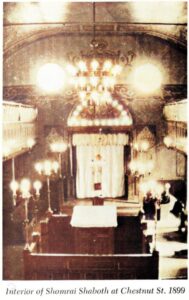 The interior of the church (sic) is prettily decorated and handsomely furnished. It is lighted by electricity, and yesterday a number of coloured incandescent globes added to the charm of the interior.
The receptacle for the Scrolls of the Law are covered with red plush, while the pulpit is upholstered with the same material. Above the pulpit are the Ten Commandments in Hebrew characters, and two painted hands, symbolic of the blessings administered by the high priest in the days of the old temple.
The officers of the Austrian Hebrew congregation are: M. Brody, president; W. Lunenfeld, vice-president; L. Gelber, treasurer; M. Gelber, corresponding secretary; H. Felcr, financial secretary
The Building Committee consisted of: H. Griesman, M. Brody, Rev. I. Halpern, L. Gelber and I. Sher. The Building Committee was heartily thanked for their earnest and successful efforts on behalf of the congregation. ♦
* * *
עד מאה ועשרים: Shomrai Shabbos turns 120 (2010)
From the Canadian Jewish News, 2010
Shomrai Shabbos Chevrah Mishnayos, the oldest extant Orthodox congregation in Toronto, commemorated its 120th anniversary in the fall of 2010.
The occasion was marked by a fundraising dinner featuring Rabbi Avraham Twerski, honouring the shul’s spiritual leader Rabbi Yacov Felder and his wife, Raisy, as well as ten congregants: Bentzion and Miriam Heitner, Harry and Shirley Marder, Moshe and Lea Reichmann, Rochelle Reiter, Bonnie Silver, and Jack and Ann Weinbaum.
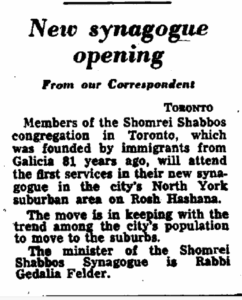 The synagogue has been on Glengrove Avenue, west of Bathurst, for 40 years. It recently underwent a major renovation that included a new beit midrash and an expanded social hall. Currently under construction, a mikvah – a rarity in the area – is expected to be ready in the spring.
Shomrai Shabbos has long been active in Toronto’s Orthodox beit din for gittin (rabbinical court for Jewish divorces) and the Kashruth Council of Canada, which was strongly associated with the synagogue and Rabbi Gedalia Felder, the current rabbi’s father, who was spiritual leader from 1951 until his death in 1991.
Former president Harry Marder, 81, a member since he arrived in Canada in 1949, characterized Shomrai Shabbos as “a very warm congregation” consisting of about 350 families.
He remembered the senior Rabbi Felder as a man with a warm personality who respected Jews of all religious affiliations – and who also served as his shadchan (matchmaker), having gotten to know Marder’s wife’s family when he served the Jewish community in Brantford.
The original congregation, known as Shomrai Shaboth Anshei Estreich Minhag Sefard, was established by a group of Galitzianer immigrants and was first housed in various locations on Richmond Street.
In 1899, a permanent home was purchased on Chestnut Street, in a building with a women’s balcony and seating for 100 men. The shul moved to the corner of Brunswick and Sussex Avenues in 1933.
Rabbi Yosef Weinreb served as rabbi for more than four decades, until his death in 1942, and the congregation was without a spiritual leader for almost a decade afterward.
The younger Rabbi Felder, 49, said the original founders “probably wouldn’t believe it” if they could see the shul and the Toronto Jewish community today. “I think they would be amazed how from humble beginnings… they planted the seeds, and they continue to blossom over 120 years later.”
* * *
From the Canadian Jewish News, 1960
“Shomrai Shabboth” — The Sabbath Observers Congregation
The Shomrai Shaboth Congregation was founded about 75 years ago by a group of Galician Jews and was then known as the “Galicianer Kehillah.” Its members constantly participated in all Jewish communal activities. Among the active members of this community today are descendants of former members of the Shomrai Shabbos Congregation.
REGULAR LECTURES
The unique feature of the Shomrai Shabbos is that the Synagogue has remained today as it was then: traditionally Orthodox with large, flourishing daily minyanim.
Rabbi G. Felder, spiritual leader, conducts regular well-attended Talmud classes on Saturdays and Wednesdays; a Chumash Rashi class on Saturday afternoon; a daily morning Mishna class; and a Ein Yaacov class. During the fall and winter months Rabbi Felder lectures regularly Wednesday evening on Talmudic and Post-Talmudic personalities.
THE FIRST ORTHODOX RABBI
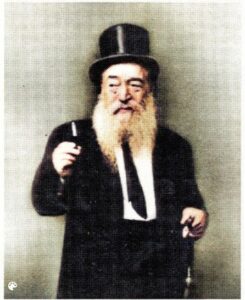 In speaking of the Shomrai Shabbos Congregation one must not forget that the first Orthodox Rabbi of Toronto, the late Rabbi Joseph Weinreb, was engaged by this congregation and served as its spiritual leader. Rabbi Weinreb was a great Talmudic scholar and exerted durable influence in our community. He was highly respected by all as a man of learning and wisdom. One can meet today in Toronto a number of people active in the religious, social and welfare life of our community who are the disciples of the late Rabbi Weinreb.
The Shomrai Shabboth Congregation in tribute to its spiritual leader has its “Talmud class ‘Mhriy Talmud Class,’” Mhriy being the first letters of Moren Harav Rabbi Yoseph Weinreb (or perhaps Moreinu HaRav Yosef Weinreb). For the yahrzeit of the late Rabbi Weinreb, his pupils, followers and disciples assemble at the Shomrai Shabbos synagogue, where Rabbi G. Felder, the spiritual leader, delivers a Talmudic discourse with reference to the Talmudic tractate studied by the group and presents an evaluation of the life and accomplishments of the late rabbi.
OFFICERS
Presently the president of the Synagogue is Mr. P. Fried; a son-in-law of Rabbi Weinreb. The vice-president is Mr. C. Freilich, a son of one of the founders of the synagogue. The gabbai are: Mr. J. Bocher and Mr. H. Shien; the recording secretary is Mr. C. Krohn, and financial secretary Mr. M. Frankel. Members of the executive and former presidents who are active in the congregation include Mr. N. Schwartz, H. Bassen, H. Krugel, and others.
The chazon of the synagogue, Mr. Solomon, conducts the services on Saturday, the High Holidays, and festivals. Cantor Solomon has been with the congregation since 1948.
THE RABBI
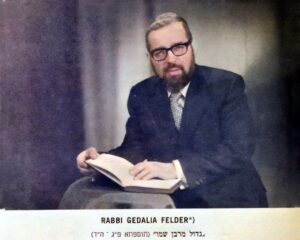 Spiritual leader of the Congregation is Rabbi G. Felder, author of three volumes of “Yeshurun,” a work dealing with the development of Jewish law and the history of the prayers of Israel; also a volume Nachlath Zvi, dealing with the laws of adoption and conversion.
Rabbi Felder contributes regularly essays on Jewish Law to “Hadrom,” a quarterly published by the Rabbinical Council of America and “Kol-Torah” in Israeli monthly.
Rabbi Felder is also active in the community at large. Presently he serves as chairman of the Toronto Rabbinical Vaad Hakashruth, of the Orthodox division of Canadian Jewish Congress and is a member of the executive of the Rabbinical Council of America, Canadian Jewish Congress, and others.
The Shomrai Shabbos Congregation remains the synagogue that shows no sign of abating or diminishing its strict adherence to tradition. Its aim is to persevere in the spirit set forth by its founders. ♦